


Few states have a relationship with Washington quite like Alaska. More than six decades after statehood, the federal government still controls roughly 61% of the land within Alaska’s borders, and disputes over natural resources, navigable waters, and promises made at statehood continue to shape the state’s political identity.
For Gov. Mike Dunleavy, those disputes are about more than land ownership. They raise fundamental questions about federalism, economic independence, and the ability of states to govern their own affairs.
As his second term draws to a close, Dunleavy spoke with American Habits editor Ray Nothstine about Alaska’s unfinished statehood promises, federal funding and state independence, and what other governors can learn from his experience challenging Washington. The conversation was lightly edited for clarity and length.
As your second term nears its end, what has governing Alaska taught you about the proper relationship between a state and Washington?
Gov. Mike Dunleavy: When Alaska became a state, the federal government required us to collectivize our resources as a condition of statehood. There’s an argument to be made about the equal footing doctrine, under which all states enter the Union, but for some reason, Alaska was treated differently. The rationale was that we didn’t have a large enough population to pay for the administration of a state the size of Western Europe.
That arrangement compels us to develop our resources. Yet since the 1970s, with the rise of the environmental movement, most administrations in Washington have tried to prohibit or inhibit our ability to do just that. Alaska was compelled to collectivize its resources to become a state, but subsequent federal administrations have done everything they can to thwart development.
The Biden administration was one of the worst. We had what we refer to as 80 sanctions against us by our own government. That is more sanctions than Iran or Venezuela faced at the time, to put that in perspective.
The Trump administration has completely reversed course, creating an environment of tremendous opportunity. We’ve opened up areas such as the Arctic National Wildlife Refuge (ANWR), the National Petroleum Reserve-Alaska, and our national forests to resource development for the benefit of Alaskans.
Unfortunately, about 61% of Alaska’s land—some 222 million acres, an area larger than Texas—is controlled by the federal government. That makes us dependent on Washington.
The proper context for federalism, in my opinion, is that the federal government and its agencies need to follow the law. But that doesn’t always happen. Instead, we often see efforts to slow things down, especially within the federal bureaucracy.
You have people at lower levels of the federal government who view Alaska as a park. They embark on their own personal missions to ensure that our ability to develop resources is slowed down.
Under President Trump, along with Secretary Burgum, Secretary Wright, and EPA Administrator Zeldin, we’ve had tremendous opportunities over the past two years. We hope that continues. But Congress also needs to enact reforms addressing litigation and permitting. If that happens, and we’re allowed to take advantage of these opportunities, I think we’ll see a better balance between the federal government and the states.
With potentially more than 20 newly elected governors preparing to take office across the country, what advice would you offer them? Where do governors have more authority to defend their states against federal overreach than they sometimes realize?
Gov. Dunleavy: Governors need to be aware that federal agencies are consistently attempting to exert control over activities within their states through legislation, federal funding, and other means. When you receive federal money, there are always strings attached, and you need to understand what those strings are. If they’re not in line with your state’s philosophy and its ability to chart its own destiny within the federal system, that can become problematic.
There are often Trojan horses coming from Washington to state capitals in various guises. Governors need to be on the lookout for those. You could find yourself on the hook for any number of obligations, including having to replace federal funding with state dollars you may not have. You might even have to raise taxes to meet mandates associated with federal programs that you never anticipated when you first accepted the money.
Before entering politics, you spent years working in rural Alaska as a teacher, principal, and superintendent. What did those experiences teach you about the limitations of distant government and the importance of local decision-making? How have those lessons shaped your approach to governing Alaska?
Gov. Dunleavy: There was an interesting saying attributed to the Russians who once controlled Alaska. Russian America was at the farthest reaches of the Russian Empire, with Moscow eight time zones to the west. The saying was, “God is high above, and the czar is far away.” In other words, Alaska was at the very edge of the czar’s reach.
In modern America, information travels at light speed. People can get on a plane and come up here, and we still have a significant federal presence in Alaska. Sometimes that works well, and sometimes it doesn’t. But the farther you go into rural Alaska, the more you depend on your neighbors, families, friends, local governments, and school districts, rather than on decisions made in Washington.
There’s a strong sense of independence in Alaska. In fact, there’s an annual national poll asking residents of each state whether they would support seceding from the Union. Alaska consistently ranks near the top, with about 38% expressing support. There’s a real suspicion of the federal government here because of things Washington has done to Alaska in the past.
In rural Alaska, there’s a tradition of independence, living off the land, and making decisions for yourself. The reach of Washington becomes more diluted the farther out you go.
You’ve spent much of your administration arguing that Washington has yet to fully honor the promises made to Alaska at statehood, particularly regarding land and navigable waters. Why does this matter beyond ownership itself? How does it affect Alaska’s ability to govern, develop its resources, and manage its own affairs?
Gov. Dunleavy: We were promised 105 million acres out of almost 400 million acres of land within Alaska’s borders. That land was selected in large part for its resources, including minerals, rare earths, oil, and gas, which would help us pay for state government.
As I mentioned earlier, subsequent administrations in Washington have tried to slow development through various means. There have been court actions, but also a concerted effort at the bureaucratic level to slow permitting and land transfers, making it difficult for us to move forward.
Then a governor’s term ends, a new governor comes in and has to learn what’s going on, and the cycle repeats itself.
Land transfers are a huge issue. We still had roughly 5 million acres owed to us by the federal government dating back to 1959. Under President Trump and Interior Secretary Doug Burgum, the federal government has recently transferred between 1.2 million and 1.4 million acres to Alaska.
The reach of Washington becomes more diluted the farther out you go.
We’re looking at another 800,000 acres soon, followed by a mechanism to transfer the remaining roughly 2.4 million acres. Hopefully, that will happen before President Trump leaves office. It would complete our land selections, which is remarkable given that it should have happened decades ago.
When it comes to rivers and lakes, Alaska has more freshwater than any other state by a factor of three. We use our rivers and lakes as highways. We literally have ice roads in the winter, and these waterways have historically been essential for traveling from one part of Alaska to another.
The federal government was supposed to transfer those bodies of water to the state as part of statehood. But federal agencies have slowed that process for decades. It’s been like pulling teeth to get them to recognize which bodies of water are navigable and belong to Alaska.
Under the current administration, that process is speeding up. We hope to settle much of this before it’s too late. It’s really about fulfilling the promises the federal government made at statehood.
Alaska is different from other states in another way. Every now and then, you’ll see an advertisement online saying, “Save Alaska. Donate Money.” This isn’t a criticism of other states, but you rarely see an ad saying, “Save Delaware. Donate Money.”
Alaska is a beautiful state, and there’s this belief that we should shut down development to avoid making the same mistakes made on the East Coast. But that runs counter to the entire purpose of the Alaska Statehood Act and why we became a state. We have these resources to develop for the maximum benefit of all our people.
One of the challenges for federalism is that states can resist federal control while remaining financially dependent on Washington. Take Louisiana, for example, where roughly half of state revenue comes from federal funds. Alaska, like every state, also receives substantial federal funding. How can states prevent that financial relationship from becoming a loss of practical independence? Is that a concern for you as governor?
Gov. Dunleavy: Yes, it’s difficult when you have money dangled in front of you. There are a number of us in Alaska who would prefer to have the unfettered right to develop our lands. We had great representation in Washington for many years with Congressman Don Young and Senator Ted Stevens. They worked to remove regulations and speed up permitting so we could develop our mining, timber, oil, and gas resources.
In the meantime, you still have to build infrastructure, roads, and energy projects. The difference between Louisiana and Alaska is that roughly 61% of our land is federally owned or impacted. That percentage is much smaller in Louisiana. I know the governor there is a great guy, but I can’t really speak to Louisiana’s share of federal funding.
In Alaska, there’s also a unique relationship between the federal government and our Native population. Alaska has the highest proportion of Native Americans of any state, at roughly 20% of our population. There’s a direct relationship between Alaska Native communities and Washington through the Department of the Interior.
There are also federal programs supporting wastewater infrastructure in rural Alaska, where we still have communities without running water or sewer systems. We understand the need for some of those programs.
But in the end, we’d much prefer the ability to develop our own resources and pay our own way, rather than having to look to Washington to fund infrastructure projects and other programs.
Alaska has enormous energy resources at a time when Americans are increasingly concerned about rising energy costs, which affect everything from food prices to household expenses. What would it take for Alaska to play an even greater role in providing affordable, reliable energy to the rest of the country?
Gov. Dunleavy: Alaska has hundreds of years’ worth of coal. We also have North America’s only supergiant oil field, Prudhoe Bay, which has produced more than 18 billion barrels of oil shipped through the pipeline. We anticipate another 16 to 18 billion barrels.
We’re undergoing a renaissance on the North Slope with the Trump administration opening up the National Petroleum Reserve-Alaska (NPRA) for more oil exploration and development.
We’ve just reversed our decline in oil production. We were producing around 455,000 to 460,000 barrels a day, and now we’re over 500,000 barrels with new fields coming online. By 2034 or 2035, we could be producing 900,000 barrels a day. We’re doing our part.
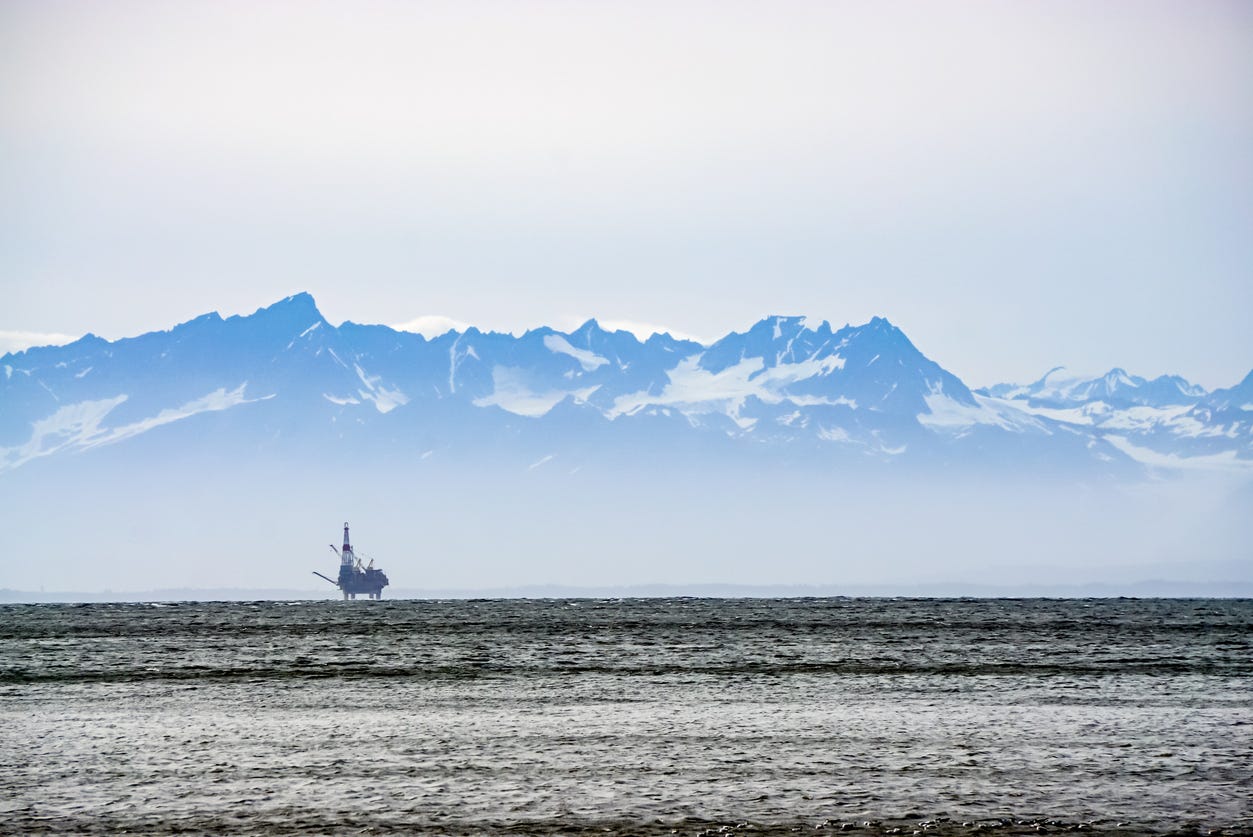
We also have 200 trillion cubic feet of natural gas. President Trump recently announced that the federal government would take the lead in developing our massive Alaska natural gas pipeline project. That would allow us to deliver gas to Alaskans, our Asian allies, and potentially the rest of the United States.
In the end, Alaska has punched way above its weight in contributing to America’s energy supply and the world’s energy supply. We want to continue doing that.
States like California have largely shut down oil exploration and, more importantly, the processing of crude oil. That’s become problematic for them. They end up importing oil rather from the Middle East and other places rather than refining it themselves.
We simply want to use common sense to develop the resources we have. If we do that, we can help not just Alaska, but much of America and our Pacific allies as well.
On a more personal note, you came to Alaska as a young man and never left. What was it about this place that got a hold of you and made you want to stay?
Gov. Dunleavy: It’s a two-part answer. First, I’ve always loved the outdoors, and I wanted to go to the ultimate place in America, and probably the world, for outdoor activities and wilderness. Alaska never fails to deliver on that.
But the reason I’ve stayed is because of the people. It’s a very unique group of people who have evolved with the land. I’m not just talking about Alaska Natives, although I lived in rural Alaska for 20 years. My wife is an Alaska Native from that region, and our kids were born there.
Even the people who came from other parts of the Lower 48 have something different about them. There’s a lot of independence, and they’re great people. If you have a flat tire and you’re stuck in the middle of nowhere, they’ll give you the shirt off their back.
It’s a combination of the beauty of this place, the wilderness, and the people that keeps me here. Great people, great place.
At a time when so many Americans are moving south, Alaska’s state motto, “North to the Future,” offers a different perspective. After more than 40 years in Alaska, what does that phrase mean to you today?
Gov. Dunleavy: America affords us incredible economic opportunities at the individual, state, and national levels. But it also affords us the ability to live the way we want to live. We take those things for granted because they’re built into our DNA. But when you visit other countries, you realize how different America is.
Alaska has always positioned itself as America and so much more. If you want to be free, you can come to Alaska. If you want to make money, you can come to Alaska. We have one of the highest per capita incomes in the nation and one of the lowest poverty rates. If Alaska were its own country, our GDP per capita would rank among the highest in the world. Economically, you can do well here, but you can also live the life you truly want.
Alaska is a bit of a niche for people. You mentioned the Sun Belt. If you don’t like the cold, which most people don’t, Alaska is going to be tough on you. But if you don’t mind the cold and love the outdoors, whether it’s the mountains, rivers, vast stretches of untouched wilderness, our coastline that’s as long as the rest of the United States combined, or our islands, the list goes on and on.
It’s almost impossible to replicate what we have here anywhere else on the planet.