


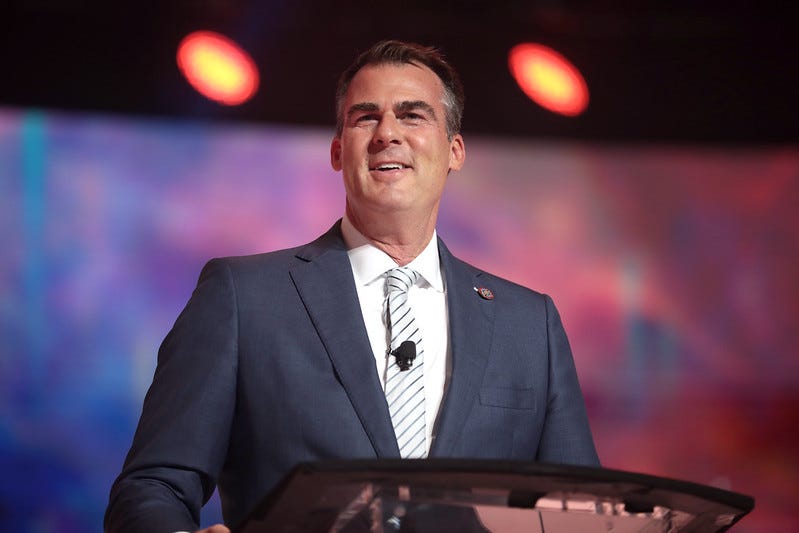
Oklahoma Gov. Kevin Stitt was first elected in 2018 and reelected to a second term in 2022. A businessman before entering politics, Stitt has made economic growth, education reform, and greater independence from Washington central priorities of his administration. As he approaches the end of his second term, Stitt spoke with American Habits editor Ray Nothstine about federalism, parental choice, the American dream, and what makes Oklahoma unique.
I was reading through some of your previous State of the State addresses, and you noted that the federal government isn’t always a reliable partner, particularly when it comes to shutdowns and responsible state budgeting. Where else can Oklahoma exercise greater independence from Washington?
Gov. Kevin Stitt: There are tons of them. About 40% of our budget comes from the federal government. We’re closer to the people. I think it’s a reminder for all Americans that our Founding Fathers divided powers between the federal government and the states. They gave more authority to the states. We created the federal government. We wanted it limited. We wanted it doing very few things because New York is different from Oklahoma, Virginia is different from Delaware, and Florida is different from Texas.
I think we need to get back to that idea of federalism. A perfect example is SNAP benefits. That’s a federal program, and they require us to do certain things. I’m trying to run things more efficiently, and we’re finding that EBT cards are being used fraudulently in New York City.
I’m thinking, “Okay, let’s geofence them and only allow them to be used in Oklahoma. Don’t we want to support Oklahoma grocery stores?” Then I find out we’ve got to play “Mother, May I?” with the federal government and get a waiver. Every time we turn around, we’re handcuffed in how we can administer these programs.
I could go on and on, but the fact is that Minnesota, for example, lost all that money in its child welfare department. We lose sight of what money is because we think of it as federal money instead of our tax dollars.
Even in Republican states like Oklahoma, we find ourselves saying, “If we don’t get the federal money, then it’s going to California or New York or Minnesota. We might as well get everything we can.” Instead, we should be changing the incentives and letting the money stay in Oklahoma rather than having it wash through the bureaucracy in Washington, D.C.
I talked to Michigan Sen. Ed McBroom, who expressed similar frustrations over SNAP benefits being used in states like New Mexico and Arizona. You’ve already touched on this, but where do you think governors too often behave like administrators of federal programs rather than chief executives of sovereign states? We don’t hear that word, sovereignty, as much as we probably should.
Gov. Stitt: Another example is that we’re closer to our workforce than somebody in Washington, D.C. As chair of the National Governors Association, I put together a bipartisan working group of Republican and Democratic governors to develop immigration policies. I was shocked to find broad agreement, even among Democratic governors, that we need secure borders. That’s first and foremost. We’ve got to have public safety.
We also believe governors should be able to issue workforce permits. If there’s a company in Oklahoma vouching for an employee, that’s who we want here, chasing the American dream, paying taxes, and contributing. Now, if you don’t have a job, if an employer isn’t vouching for you, then you have no permit, and you’re out of the country. Now we know who to actually get out of the country. If you break the law, of course, you’re out of the country.
Every time we turn around, we’re handcuffed in how we can administer these programs.
We’re overthinking this issue. You’ve got everybody sneaking around trying to employ people because their businesses are at stake.
The governor of Maryland is closer to his fishing industry than I am. The governor of Louisiana is closer to his fishing industry than somebody in Washington, D.C. Why don’t we let governors issue workforce permits instead of somebody in Washington?
Education has been one of the defining policy battles of your tenure, particularly around parental choice. What does education policy teach us about why decisions affecting families are often better made closer to home? I live in North Carolina, where we’ve expanded Opportunity Scholarships. As a middle-class family, we’ve benefited from having more educational options for our children.
Gov. Stitt: I’ll argue our point of view every single day on this. First off, rich people already have school choice. Everybody needs to remember that. They move to the best neighborhoods. They can put their kids in the best private schools. What about that single mom who has to get up and go to work every day, and she’s in a failing school district?
During COVID, Tulsa Public Schools decided to shut their schools down for 355 days. These single moms would call me in tears because their first-graders were falling behind. They weren’t learning how to read on Zoom, while their neighbors’ kids were in school the whole time in another district.
I got very passionate about this. We now have open transfers in public schools. You can decide to go to another school. We also have a refundable tax credit that allows you to take your money and go to a private school. We’re encouraging more charter schools. We believe in religious charter schools.
I think it’s about putting parents back in charge and creating competition in our education system. We don’t have one government grocery store. We allow competition to work.
Even with EBT cards, you’re not required to shop at one government grocery store. You can go to any private-sector grocery store, and those stores compete for your dollars. I look at education the same way. We know competition works, free-market systems work, and we want to inject that into the education system. We want parents to choose what’s best for their son or daughter, rather than having their school predetermined by their ZIP code.
That doesn’t make sense to me when you could have a failing school, high dropout rates, gangs, violence, bullying, or a school that doesn’t offer the programs your son or daughter excels in. We want to open up more options for these kids and make school districts compete for those students. That’s the greatest approach I can think of.
Governor, you’ve expanded school choice while also increasing state education spending. Does Oklahoma’s experience challenge the assumption that we must choose between funding public schools and giving families more educational options? How has that worked in your state?
Gov. Stitt: Yes, I think that’s a bad debate. I’ve been increasing public funding for our education system. By creating competition and having the money follow students, guess what? Some school districts that are excelling and delivering higher test scores will have more money to expand and grow. The ones with high dropout rates and horrible test scores shouldn’t get as much money.
We’re putting money into education, but as long as that money follows the student, what are we really trying to do? Are we trying to fund a ZIP-code school, or are we trying to fund little Johnny’s education and get him ready for the workforce?
We did one other thing. With our refundable school tax credit, we created a separate bucket of money. If a kid leaves the public school system, the per-pupil funding actually goes up because the tax credit comes from a separate bucket of money. That’s the way we did it in Oklahoma to take that argument away.
You’ve emphasized economic growth and entrepreneurial opportunities during your tenure, and Oklahoma has attracted significant investment. At the same time, socialism, or at least greater government intervention in the economy, seems to be gaining appeal, particularly among younger Americans. What would you say to those who are attracted to those ideas?
Gov. Stitt: First off, I would say socialism 100% doesn’t work. Free markets, a strong middle class, and the ability to chase the American dream are what have made our country so great. Socialism creates the haves and the have-nots. You have elites living at the top, where everything becomes political, and everybody else is left behind. There’s this utopian idea that equal outcomes are possible. It doesn’t work.
I would encourage everybody to look at the oppression and lack of upward mobility in socialist societies. You’ve got to use your head. I try to tell young people that life is going to be hard and challenging, but in America, you have the opportunity to work hard, dream big, and accomplish anything you set your mind to, regardless of the circumstances of your birth. It’s not like that in other countries, and certainly not in the socialist world.
Governor, you’ve talked throughout your tenure about making Oklahoma a top-10 state. As you approach the end of your time in office, what’s different about Oklahoma today that people outside the state might not fully recognize or appreciate?
Gov. Stitt: I tell people all the time that the intangible thing that’s happened since I’ve been governor is that Oklahoma is winning. We’re top 10 in people moving to our state for the first time ever. We have a thriving economy, and we’re the most business-friendly state in the country. We’re a one-phone-call state, so it’s easy to start a business here.
I think that’s something I’m really proud of, this idea that the American dream is alive and well in our state. I have people moving here from California and other states saying, “Man, it’s the way it used to be in my state when I grew up, and now that’s the way it is in Oklahoma.”
We get government out of your life and allow you the freedom to live your life. We don’t dictate mandates, mask mandates, or this or that. We’re transparent with the data, but we believe in personal responsibility and individual freedom.
Governor, we live in a rapidly changing world. When somebody says, “I’m an Oklahoman,” what do you hope that still means 100 years from now?
Gov. Stitt: Man, I hope it means they can still chase their American dream, that they can own a home, that government is limited, that the free market exists, and that they can dream big and accomplish anything they set their minds to. I love what our friend [Rep. Rob Hall] said: “We’re an elite state, but we’re not made up of a bunch of elitists.”