


The only aspect of the midterm elections I found surprising was the sheer depth of the Republican collapse. I knew it would be bad for Republicans. All the signs were there, especially in my home state of North Carolina. But it was even worse than predicted.
Even supposedly safe Republican seats fell, including that of U.S. Rep. Richard Hudson in North Carolina’s 9th Congressional District. As chairman of the National Republican Congressional Committee, Hudson had the unenviable task of preserving the Republican House majority, making his own defeat one of the more telling symbols of the magnitude of the Democratic wave.
The obvious reasons for the shellacking include the rising cost of living, the unpopular conflict in Iran, too many subpar candidates, and perhaps most importantly, the failure to offer voters a coherent plan to address their growing economic anxieties.
Consider just a few examples of the candidate problem. Republicans might well have retained their U.S. Senate seat in South Carolina had they nominated Ralph Norman instead of Darline Graham. In Mississippi, Sen. Cindy Hyde-Smith is fighting for her political survival. The betting markets are heavily predicting a loss for her. Much could be said about her deficiencies as a candidate, but her failure to hold a town hall in six years is telling. And in Texas, it’s unclear whether a stronger Senate candidate would have made much difference, given the magnitude of the Republican defeat there.
But amid the Republican wreckage, Florida stands out.
Gov. Ron DeSantis may be the clearest political winner on the Republican side after Tuesday’s elections. Florida demonstrates the power of conservative governance rooted in federalism, where strong state leadership and a willingness to challenge Washington helped insulate it from the national Democratic wave.
DeSantis has repeatedly challenged Washington on spending, even publicly rebuking President Trump’s proposal to send $5,000 checks to Americans as another idea that would fuel debt and inflation. Rather than simply falling in line with the national party, he remained focused on his own state’s priorities and showing how to accomplish a bold conservative agenda.
That included championing Amendment 3, a property tax relief measure that helped energize conservative voters in an otherwise difficult election. Florida voters overwhelmingly approved the amendment, delivering an important policy victory even as Republicans elsewhere suffered historic defeats.
DeSantis also secured policy victories at the state level that Republicans in Washington have struggled to deliver, including the Florida SAVE Act, which strengthened citizenship verification requirements for voter registration.
Florida’s Republican gubernatorial victory is all the more remarkable given what happened elsewhere, particularly in Texas, where Democrats ended more than three decades of Republican control of the governor’s office. The last time Democrats had a U.S. Senator elected in Texas was Lloyd Bentsen in 1988. Remember him? He was also Michael Dukakis’s running mate during the 1988 presidential race.
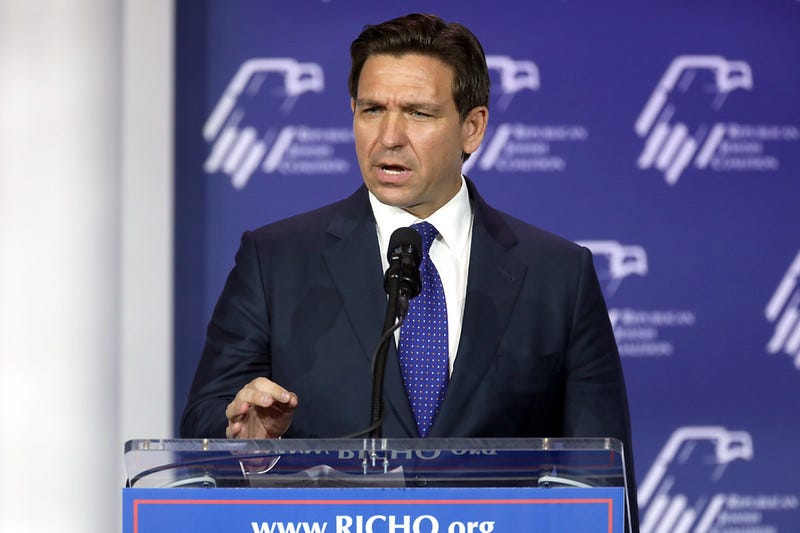
To his credit, DeSantis managed to put some real distance between himself and the Trump administration and Republicans in Congress. He criticized excessive spending and was willing to speak out against corruption and other failures of governance. Whether that independence will help him in another presidential campaign remains to be seen. But after Tuesday’s results, the political necessity of Trump’s endorsement may matter considerably less than it once did. It might even turn out to be a net negative.
Outside of DeSantis, the larger takeaway for those on the political right is fairly simple. Conservative candidates need to reclaim the mantle of limited government and better articulate why limits on government power matter to citizens in a republic. This is especially true given the appeals of socialism to so many frustrated voters.
At American Habits, I’ve so often returned to the words of George Mason, included in several state constitutions, about what is necessary to preserve free government:
That no free government, or the blessings of liberty, can be preserved to any people but by a firm adherence to justice, moderation, temperance, frugality, and virtue and by frequent recurrence to fundamental principles.
When a political agenda goes awry, it’s worth returning to first principles. Limited government, free markets, spending restraint, and the importance of virtuous citizens and candidates are needed now more than ever.
And while Republicans were decisively rebuked at the polls, it doesn’t necessarily follow that conservative principles suffered the same fate. Indeed, many Republicans have spent years drifting away from those principles themselves. Here in North Carolina, where the election was disastrous for the Republican Party, voters still approved the entire slate of conservative-backed state constitutional amendments, including two that placed further limits on taxes.
I’ve long accepted that politics and elections are generally cyclical. Democrats may well interpret their historic victory as a mandate for policies considerably further to the left than many voters actually want. Eventually, another electoral rebuke will come. But the depth of this Republican defeat suggests that the party’s recovery may take more than a single election cycle. The turnover is likely too deep over large swaths of the country given that the nation mostly faces divided government in D.C.
But back to the lesson from Florida. Washington remains broken, and Gov. DeSantis’s leadership offers a roadmap for other states to challenge the big-spending status quo and resist the increasingly nationalized, one-size-fits-all approach to governing. In some respects, the election offers a vindication of federalism and a warning to states against tying their fortunes too closely to Washington’s political dysfunction or a single national leader. Democrats may interpret their victory as a mandate for sweeping left-wing reforms, but America remains crippled by debt and rising consumer costs. Kitchen table issues are virtually impossible to sidestep. And while Democrats successfully campaigned on the cost-of-living crisis, they won’t solve it by expanding the size and reach of the federal government. That only exacerbates an already serious problem facing Americans.
Ray Nothstine is a Future of Freedom Fellow and senior editor and writer at State Policy Network. He also edits American Habits, a publication dedicated to federalism and the habits of self-government.